Spexi: AI assisted product development
I helped shape an AI assisted product design workflow that turned early ideas into working prototypes, tested them with customers, and gave Product and Engineering clearer evidence before investing further in design and development.
- Role
- Senior UX/UI Designer, sole designer
- Timeline
- 2025–2026
- Products
- Pilot Android app, pilot web app, customer web app
- Focus
- AI assisted workflows, product design, customer testing, design systems
01 · The challenge
One designer, many complex conversations
Spexi is a geospatial platform for capturing and delivering drone imagery.
As the sole product designer, I worked across three products with Product, Engineering, leadership, operations, pilots and customers.
New ideas often began in documents, wireframes or conversations. Without something tangible, teams could interpret the same idea differently and important questions often surfaced later than they should.
Key insight
The bottleneck was not ideas.
It was creating shared understanding early enough to make better decisions.
02 · The approach
Make ideas clear early, then make them shippable
I used AI to turn early concepts into working experiences that teams and customers could interact with before significant design or engineering investment.
A · Prototype and test early
For Request Capture, I used Claude to build a functional customer flow for requesting new aerial imagery.
Product and Engineering could evaluate how the experience behaved, while live customer testing revealed where people hesitated, misunderstood the flow or needed more information.
This gave us clearer evidence about what to change before moving further into design and development.
B · Build the foundation
I worked with Product and Engineering to unify Spexi’s Figma design system and align components and tokens with code.
This created a consistent foundation for moving validated ideas toward production across all three products.
03 · Key decisions
Where I chose to focus
-
Ideation, alignment and testing
I used working prototypes to explore ideas, align Product and Engineering, and test flows with customers before committing more time.
-
Clearer handoffs and documentation
Because the AI workflow already contained our testing, decisions and product context, prototypes could support clearer handoffs and help turn that knowledge into documentation.
-
Connect AI to the design system
I kept the design system connected to the AI workflow, adding new rules and updating components and tokens as the system evolved.
This meant each new prototype started closer to the final product instead of beginning from a generic AI output.
-
Deliver final designs through the system
Validated directions were refined into final designs using the shared design system, creating a more consistent path into development.
“She consistently advocates for AI driven design initiatives that help increase our front end development velocity, improve collaboration between design and engineering, and accelerate delivery without compromising user experience.”
 Erica HaightHead of Product, Spexi
Live prototype
Try the Request Capture prototype
A working prototype I built to explore how customers could request new aerial imagery.
Draw or import an area, see valid hexes and estimated credits, choose imagery products and step through the request flow.
Open the live prototype Opens in a new tab · Best on desktop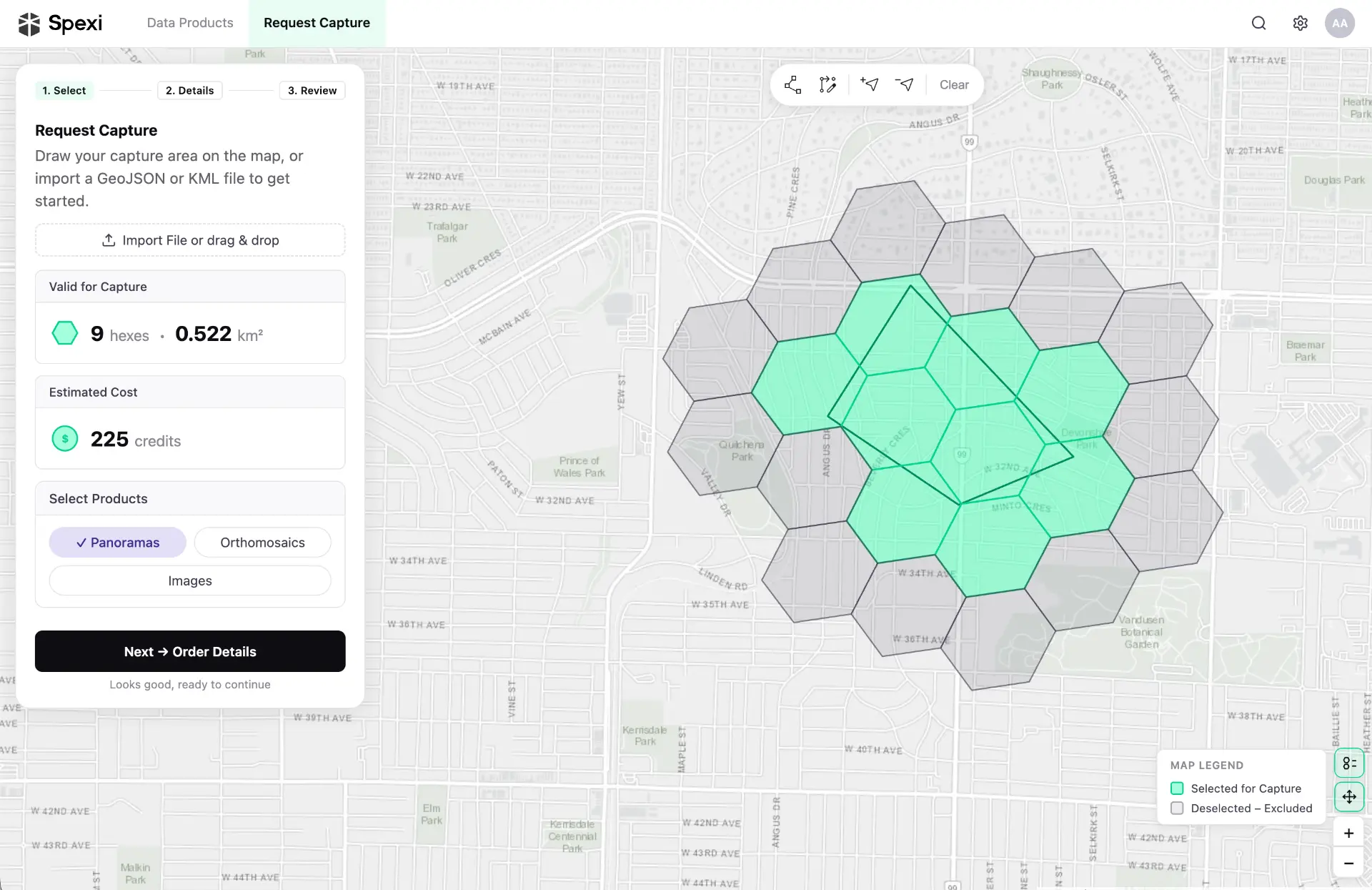
04 · Outcome
Build a system that could scale beyond one designer
My goal was to move Spexi toward a product workflow where AI could eventually generate stronger designs using our design system, product knowledge and real code as its foundation.
That mattered because I was supporting three products, each with multiple screen variations across Android and responsive web, while also researching which ideas could create real business impact.
By connecting prototypes, decisions, documentation and the design system, I was building a workflow that could reduce repeated design work, speed up decisions and produce outputs that started much closer to production.
- 3 → 1products brought onto one atomic design system
- Earliercustomer friction, questions and tradeoffs surfaced before production
- 1designer supporting product design across three products